Friday, September 30, 2011

Phsyiological Blushing/Flushing

"Blushing is generally distinguished, despite a close physiological relation, from flushing, which is more intensive and extends over more of the body, and seldom has a mental source."

Physiology of Blushing: The face flushes more easily than the rest of the body for a number of reasons. More capillary loops, the blood vessels of the cheek are wider and closer to the surface, and there is less tissue fluid, making the blood vessels more visible.
Interesting note, in one experiment where they tested the effects of blocking different body chemicals in blushers and infrequent blushers, they measured level of blushing at the forehead.
-http://en.wikipedia.org/wiki/Blushing

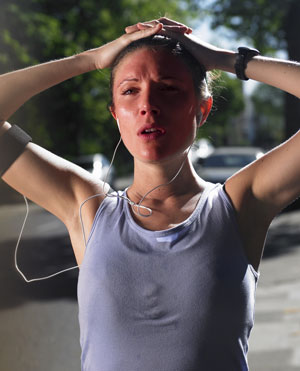
For the project we began by focusing on the flushing of the face. So when it comes to differentiating between blushing and flushing of the face, I had assumed to find some source the describes how blushing has greatest effect in the cheeks while flushing affects the whole of the face. However, it seems that blushing is "generally restricted to the face, cheeks or ears" while flushing extends to greater parts of the body. Therefore we cannot concentrate only on the face if we wish to distinguish blushing from flushing.
-http://en.wikipedia.org/wiki/Flushing_%28physiology%29

flush (verb): to cause to blush
-http://www.merriam-webster.com/dictionary/flush[4]

Flushing and blushing can occur because of sugar consumption, stress, exercise, embarrassment, etc. 
http://www.rosacea-ltd.com/flushing.php3

Pink is a very popular color for sites dealing with blushing.
http://www.social-anxiety-shyness-info.com/art/sad-shyness/a-20-blushing-face.htm

"Since you want a healthy flush, it's best to apply blush only to apples of your cheeks. Keep color light and blended." http://beauty.about.com/od/makeuptrickstips/ht/blush.htm
While this quotes a guide to applying makeup blush, it can still show us where we naturally look for blushing to occur. In particular 'cute' blushing as opposed to the flushing that results from exercise.
Blushing-applied (left) vs. Flushing (right) 


Possible measurement: "Autonomic testing was performed by means of spectral analysis of heart rate and continuous blood pressure by sparse discrete Fourier transformation"

Thursday, September 29, 2011

Gender Filter Example

This is a wonderful example of what we are trying to get at. This work is from the "Body Motion Laboratory".

Abstract:
We developed a framework that transforms biological motion into a linearized representation which enables us to apply linear methods from statistics and pattern recognition to its analysis. Initially, we used gender classification as an example and created a simple classifier, whose performance was compared to psychophysical data from human observers. However, the same approach can be used to extract information about other walker attributes as well. The proposed framework can also be used to synthetize new motion patterns with particular attributes.

Wednesday, September 28, 2011

Proposed System Diagram

1) Just animate skin deformation from initial bio-signal and motion capture data

2) Derive simple equation that map bio-signal data to organ deformations and appearance changes. Try it and compare to high dimensional mapping


3) learn parameters for block(b) using the training data
-validation
-capture new "test" data

4) Exhaustion Filter - applies parameters to novel data input

Tweaking textures

Before Kyle (our main male model) was a little too pasty for Joe's liking. His coloring looked a little too flat. When he turned red when he was exhausted, it was very dark on many screens. So Kaitlin adjusted the texture and the shaders so he would appear more striking during the 'reddining' phase.


Abstract

As a humans fatigue there is an inability to sustain performance at the level of one’s normal capabilities. Certain variables cue our perception of this exhaustion. Depth and rate of breathing can be modified in response to changing body demands, sweating increases, and blood flow flushes the face and affects balance.  We first create a database of exercise motions to demonstrate these exhaustion variables by recording motion capture data and biosignal sensors. We derive a set of parameters from this multi-modal training data. We apply these exhaustion parameters on novel input motions. Then change the input motion to display a desired level of exhaustion. (This can be either- what really happens to the user as they perform the motion, or an application of a slider so at any point an animator can get a desired level of exhaustion.

We demonstrate the practicability of this method by proposing a data-driven exhaustion filter that models the level of exhaustion in human motion on various characters and motions.


Some notes:
We want this method to work on novel input motions.
We want this method to work on a variety of characters (does it matter if they are human?)